27 March 2022 through 24 April 2022
Opening reception for the artists Friday April 1 2022, 6-9pm
Guest curated by Fabiola Carranza
Image: Jessica Buie, Exposure, color photograph
27 March 2022 through 24 April 2022
Opening reception for the artists Friday April 1 2022, 6-9pm
Guest curated by Fabiola Carranza
Image: Jessica Buie, Exposure, color photograph

27 January 2022 through 6 March 2022
Organized by Christopher Brayshaw and Steven Tong
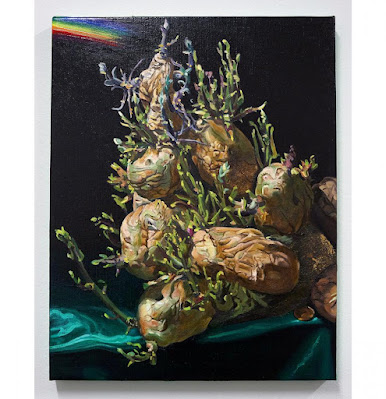
I began the first painting in this series as a tongue-in-cheek attempt to visualize a distant family member with no known photographs documenting their appearance. I knew where they came from, where they ended up, but little of their life other than their diet: potatoes. So, I painted an arrangement of potatoes on my studio table, avoiding portraiture in favour of still-life as a means of showing one thing via another, conscious that the original subject could never be depicted accurately anyway and thereby allowing metaphor to manifest in unexpected ways. In terms of process, my goal was to be as direct as possible, painting from life without photographic mediation. I wanted a kind of blunt, un-inflected naturalism, similar to that in use around the time photography first appeared (early-mid 19th century), before Impressionism and Modernism. I wanted any sense of inner-life in the subjects to come from an optical experience of their material appearance rather than embellishments of technique such as exaggerated colour or obviously gestural paint application. I also wanted to invoke a consideration of how the physical properties of the subjects were culturally and metaphorically resonant:
potatoes: you are what you eat, subterranean...
butter: solar energy store, fat, oil paint...
copper: distillation, electricity, currency, economy...
wooden sticks: folk art, the woods...
and so on...
Sean Alward is an artist based in Vancouver. His paintings explore the intersection of materials and historical consciousness. He received his MFA from the University of British Columbia and BFA from the Nova Scotia College of Art and Design. He has exhibited across Canada and in the U.S., most recently at the Art Gallery at Evergreen, WAAP Projects Vancouver/Vacation Gallery New York, AHVA Gallery at UBC, Surrey Art Gallery, and the Nanaimo Art Gallery. He has published writing in Canadian Art, C Magazine, and Border Crossings.
https://www.instagram.com/seanalward/


1 April 2021 through 9 May 2021
Organized by Christopher Brayshaw & Steven Tong
Ana Vojnovic works as an educator, artist, design researcher and a lecturer. Her pedagogical and art practices are an interdisciplinary response to urban conditions, and questions of how built/designed environments affect and condition human perception, our responses to designed circumstances and the ways we engage with each other.
Through her hand-drawn compositions and collage analysis, Ana narrates the inter-relations and intimacy between geometric language and space, and indirectly proposes multiple ways one can perceive and experience the work.
While her drawings and collage pieces are guided by the unexpectedness of inspiration and inner vision, they are performed through a deliberate, rhythmic re-working of compositional elements. As such, Ana’s work offers multi-layered engagement, one of a soothing dynamic and the activation of temporal images revealed within the white space.
For additional information on Ana’s practice and additional work(s), please visit her artist website conceptfioka.com


In Swords 2 Ploughshares (Cut Piece 2 Sew Peace), David Khang de-commissioned his butterfly-covered, bicycle-powered tank. Invoking Yoko Ono’s Cut Piece (1964), public members were invited to participate in cutting pieces of fabric from the tank, to re-purpose them into sewn masks in response to the Covid-19 pandemic. The project functions as a fundraiser for legal defence of Indigenous land defenders and water protectors in British Columbia. The masks will continue to be produced until the fabric from the tank runs out. Masks can be ordered at: cutpiece2sewpeace@gmail.com
Anthropocene 2 Symbiocene (Bombers 2 Butterflies) is a body of work that Khang produced while studying in law school. Off-cuts from the fabric used to cover the tank were collaged with paper cut-outs to produce two thematic series composed of military and animal imagery. Metamorphosis of Turtle Island is a piece that Khang produced in lieu of an academic paper for a class on Aboriginal and Treaty Rights.

10 September 2020 now extended until 29 October 2020, 7pm!
Virtual launch 10 September 2020
“When the soul wants to experience something she throws out an image in front of her and then steps into it. ”
The
sun, like the hub of a wheel, is an unmoved mover. The centre is static
yet the perimeter rotates and the result is that we trundle – or even
fly, as the case may be – onward with a cosmic momentum. The
Aristotelian theory of the “unmoved mover,” which some dismiss as
absurd, puts forth the idea that for every motion there is a mover and
that at the mystic centre, the original mover is still. This concept
speaks to the experience that the inanimate objects and images around
us, occupying a seemingly static existence, can animate shifts and
changes within our consciousness.
Rituals are created and performed in order to facilitate transformation.
A “wünshelrute” (wishing rod), dowsing rod or witching rod is an
instrument used to locate subterranean sources of water. In water
witching, when someone suspects a valuable source lying beneath, a
ritual search or sacred sourcing is performed to locate and move toward
that which could nourish and sustain.
In A Dictionary of Symbols, J.E. Circlot writes “to leave the
circumference for the centre is the equivalent of moving from the
exterior to the interior, from form to contemplation, from multiplicity
to unity, from space to spacelessness, from time to timelessness.” Unmoved Movers is
an inquiry into the perennial and regenerative nature of symbols that
are revitalized with each contemplation and explores the idea of symbol
as “mover.”
__________
A body of water, The many within the one, Towards centre, Darkness & light, Energetics, Towards expansion, Her proliferated reflections and The Braid are
a series of painted papier-mâché witching rods that rest at the edges
of the gallery, leaning with upward reaching arms, poised for
conduction. These sculptures take the forked form of a Y, a symbol that
has been associated with the sacred feminine and evokes both celebration
and connectivity.
Cotton fabric is pulled in measured loops through a woven backing to create the hooked rug. Here, at the edge of things is a two-part textile work that suggests adjacent thresholds or portals. Sun wheel and Nyx explore
the collectively experienced transitional spaces of sunrise and
moonrise and welcome contemplation of the liminal spaces occupied in the
everyday.
\
Heidi Meixner works in sculpture, painting and textiles. Her practice is
inspired by folk art and traditions as well as alternative
philosophies. Through slow-process materials and techniques, she
explores the relationship between ritual and the everyday as an antidote
to the pace and modes of engagement in contemporary culture. She is
continuously drawn to the soft, versatile and buffering nature of
textiles and is motivated by the vast history and contexts of fibre art.
She lives on the traditional unceded territories of the Musqueam,
Squamish and Tsleil-Waututh Nations known as Vancouver, B.C. In 2009 she
received a Bachelor of Fine Arts degree in visual arts from Simon
Fraser University.